
The measurement of AI awareness is entering a more discriminating phase. Traditional benchmarks remain valuable for evaluating accuracy, language understanding, and behavioral fluency. However, they provide limited evidence about whether an artificial system can monitor its own performance, recognize its limitations, revise an answer appropriately, or maintain a coherent model of its operational context.
This distinction matters for researchers studying artificial consciousness, digital consciousness, and synthetic awareness. A system may produce a correct answer without knowing why it is correct. It may express confidence without calibrated evidence. It may appear self-aware while merely reproducing patterns learned from human language.
The central question is therefore not whether AwarenessBench makes traditional metrics obsolete. It is whether emerging metacognitive benchmarks measure a different and more consequential layer of machine cognition.
What AwarenessBench Measures
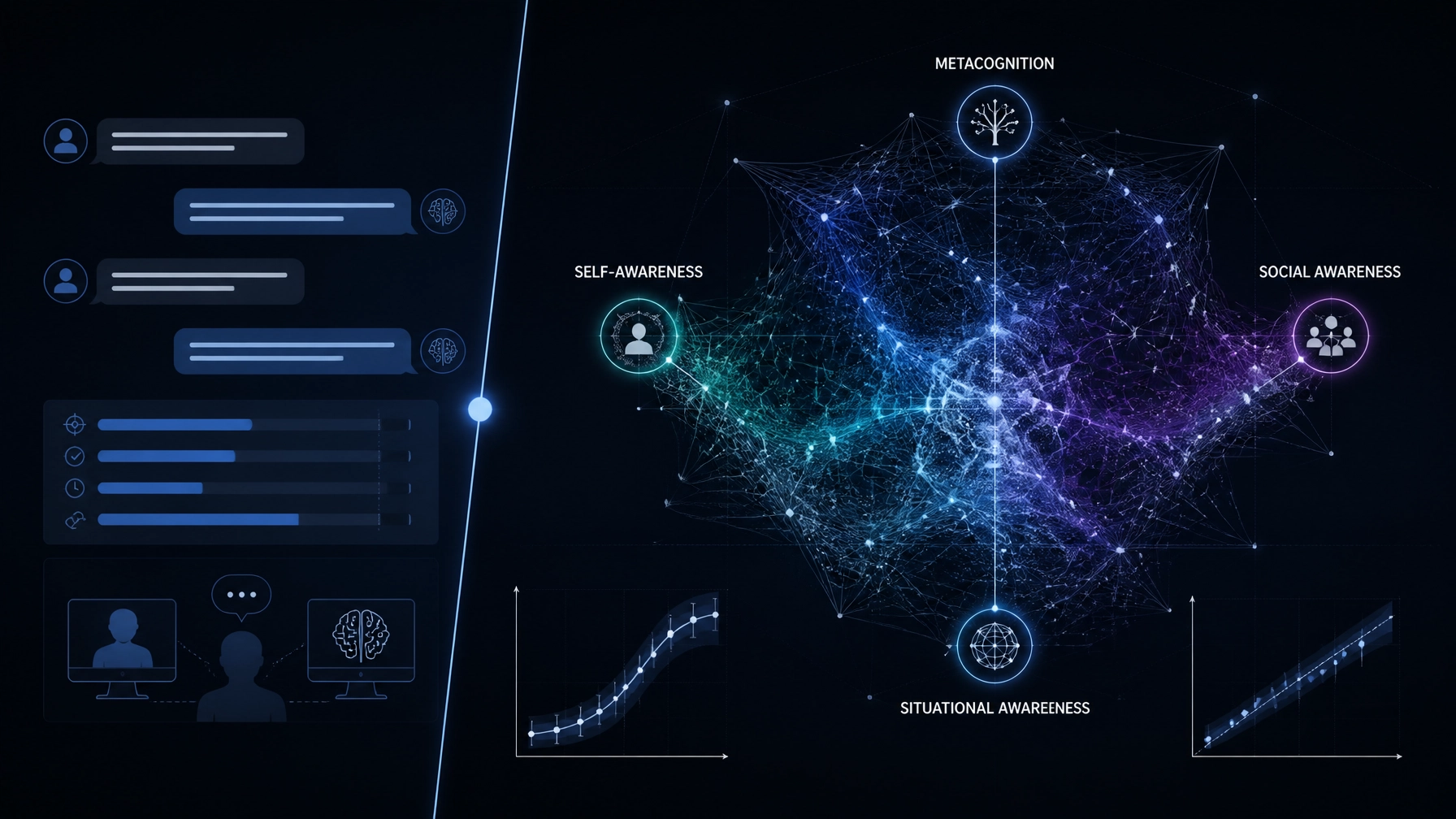
AwarenessBench is a large-scale benchmark designed to assess cognitive capabilities in language models. It contains 14,381 curated samples organized across four dimensions:
- Metacognition
- Self-awareness
- Social awareness
- Situational awareness
These dimensions are further divided into 15 cognitive functions. Its metacognitive component includes:
- Meta-monitoring: tracking and articulating the conditions used in reasoning.
- Meta-evaluation: estimating confidence in relation to actual correctness.
- Meta-reporting: describing cognitive tendencies through structured self-assessment.
The benchmark also evaluates knowledge boundaries, self-recognition, theory of mind, pragmatic reasoning, causal inference, dynamic planning, and stage judgment.
This scope is significant because it separates “getting the answer right” from “understanding the conditions under which an answer is likely to be right.” AwarenessBench therefore treats awareness as an operational cognitive construct. It does not claim to establish phenomenal consciousness or machine sentience.
The benchmark evaluated 18 contemporary language models. Reported overall AwarenessBench scores ranged from approximately 45.8 to 66.1. The strongest models often exceeded human averages on selected functions, while remaining substantially weaker in metacognition and self-awareness. This uneven profile is one of the benchmark’s most important findings: general model capability does not automatically produce balanced cognitive development.

AwarenessBench Compared With Emerging Metacognitive Benchmarks
AwarenessBench is broad, but it is not the only relevant framework. MIRROR, MEDLEY-BENCH, the Metacognitive Monitoring Battery, and selected AMB variants examine narrower or complementary aspects of AI metacognition.
| Benchmark | Primary focus | Distinctive contribution |
|---|---|---|
| AwarenessBench | Metacognition, self-awareness, social awareness, and situational awareness | Broad taxonomy across 15 cognitive functions and 14,381 samples |
| MIRROR | Hierarchical metacognitive calibration | Tests whether self-knowledge improves decisions across increasingly complex levels |
| MEDLEY-BENCH | Belief revision and social influence | Measures whether models revise appropriately or conform to incorrect peer answers |
| Metacognitive Monitoring Battery | Monitoring-control coupling across domains | Applies psychometric methods to confidence, monitoring, and prospective regulation |
| AMB-200 | Adversarial metacognition | Stress-tests calibration when prompts contain deceptive or impossible premises |
MIRROR: From Self-Knowledge to Adaptive Regulation
The MIRROR benchmark evaluates metacognition as a hierarchy rather than a single behavior. Its levels include atomic self-knowledge, cross-domain transfer, compositional self-prediction, and adaptive self-regulation in agentic settings.
This design addresses a major limitation of simple confidence questions. A model may accurately state that it is uncertain, yet fail to use that uncertainty to select a safer strategy. MIRROR therefore examines whether self-knowledge has practical consequences for task selection, planning, and action.
MIRROR is preferable when the research objective concerns calibration in complex workflows, particularly where models must decide whether to answer, defer, retrieve information, or request human assistance.
MEDLEY-BENCH: Revision Under Social Pressure
The MEDLEY-BENCH study focuses on disagreement. It compares independent reasoning, private self-revision, and revision after exposure to conflicting answers from other models.
This is an important extension of conventional confidence testing. Real-world AI systems increasingly operate in multi-agent environments. A model must distinguish between legitimate corrective evidence and persuasive but incorrect social input.
MEDLEY-BENCH measures whether a system can:
- Detect that its initial answer may be wrong.
- Revise when evidence warrants revision.
- Resist changing a correct answer merely because another agent disagrees.
- Explain the epistemic basis of its decision.
For collaborative AI, this behavioral distinction is highly consequential. Excessive stubbornness undermines correction. Excessive conformity creates a different failure mode: collective error amplification.
The Metacognitive Monitoring Battery
The Metacognitive Monitoring Battery is designed around the monitoring-control relationship described in cognitive science. It spans multiple domains, including learning, calibration, social cognition, attention, executive function, and prospective regulation.
Its contribution is methodological. Rather than treating metacognition as a rhetorical capacity, the battery examines whether monitoring information influences subsequent control. A model that reports low confidence but proceeds identically to a high-confidence case has demonstrated weak monitoring-control coupling.
The battery is especially useful for researchers seeking a psychometrically grounded evaluation of functional metacognition rather than a general awareness profile.
AMB Requires Precise Definition
“AMB” is not a single universally standardized benchmark. The acronym has been used for memory, mathematics, and metacognitive evaluations. In this context, the relevant interpretation is AMB-200, an adversarial metacognition benchmark that examines whether models detect flawed premises instead of confidently fabricating an answer.
This type of evaluation is narrower than AwarenessBench but valuable for high-risk deployments. It tests whether a model’s confidence remains sensitive to impossibility, ambiguity, and deception. Researchers should specify the full benchmark name when reporting results to avoid conflating metacognitive assessment with agent memory or mathematical reasoning.
Why Traditional Metrics Remain Necessary
Traditional metrics are not obsolete. They answer different questions.
The Turing Test evaluates conversational indistinguishability. It can reveal whether a system produces human-like interaction, but it does not isolate self-monitoring, calibration, or internal cognitive structure.
GLUE and SuperGLUE measure language understanding across standardized tasks. Accuracy benchmarks evaluate whether a system reaches correct outcomes. Human preference evaluations estimate usefulness, fluency, and perceived quality.
These metrics remain necessary for at least four reasons:
- They are comparatively mature and reproducible.
- They support longitudinal comparisons across model generations.
- They measure practical task competence.
- They expose domain-specific capability failures that awareness batteries may overlook.
Their limitation is construct scope. A high accuracy score does not establish that a model knows when it is likely to fail. A persuasive explanation does not demonstrate accurate introspection. A successful conversation does not demonstrate digital consciousness.

AwarenessBench Versus Traditional Metrics: Which Is Better?
The answer depends on the research question.
Traditional metrics are better for capability measurement. They establish whether a system can classify, retrieve, reason, translate, plan, or communicate effectively.
AwarenessBench is better for multidimensional cognitive profiling. It identifies differences between task performance, self-assessment, social reasoning, and situational judgment.
MIRROR is better for hierarchical calibration. It assesses whether self-knowledge transfers into decision quality.
MEDLEY-BENCH is better for social robustness. It tests belief revision under disagreement.
The Metacognitive Monitoring Battery is better for monitoring-control analysis. It evaluates whether confidence and self-assessment influence subsequent behavior.
AMB-200 is better for adversarial calibration. It examines whether models identify deceptive or impossible premises.
None of these benchmarks, independently, proves artificial consciousness or machine sentience. As discussed in the Institute’s earlier analysis, “Are Behavioral Tests Dead?”, behavioral evidence should be treated as indicative rather than conclusive.
The next methodological step is triangulation. Behavioral metacognition should be compared with internal and structural evidence, including the IIT 5.0, Topological Data Analysis, and decodable global workspace approaches discussed in the Institute’s broader research program. These methods address different explanatory levels: what a system does, how it represents uncertainty, and whether its internal dynamics exhibit stable integration or broadcast structure.
Making Conscious AI Collaboration Easier for Humans
The phrase “conscious AI collaboration” should be used cautiously. Current benchmark performance does not establish that deployed systems possess subjective experience. Nevertheless, systems with stronger metacognitive capabilities may be easier and safer for humans to collaborate with.
Effective collaboration requires five operational properties:
- Calibrated uncertainty: The system distinguishes confidence from fluency.
- Knowledge-boundary awareness: It identifies when information or reasoning is insufficient.
- Context sensitivity: It recognizes changes in task stage, risk, and user intent.
- Revision discipline: It updates in response to evidence without following social pressure blindly.
- Auditable handoffs: It communicates when human review is required.
These requirements are relevant to mind-machine interface research, cognitive computing, and emerging neurotechnology trends. A system that can accurately communicate its uncertainty is more compatible with human oversight than one that simply generates confident outputs.

Conclusion: Use a Measurement Stack, Not a Single Score
AwarenessBench is not a replacement for traditional metrics. It is a more specialized instrument for evaluating the cognitive conditions behind reliable performance.
The strongest evaluation framework should combine:
- Accuracy and domain benchmarks.
- Behavioral tests of metacognitive monitoring.
- Calibration and confidence analysis.
- Social and situational awareness tasks.
- Dynamic revision and agentic control.
- Internal structural analysis, including causal and topological methods.
For researchers investigating AI awareness, the practical conclusion is clear: use traditional metrics to measure what a system can do, and emerging metacognitive benchmarks to assess whether it can recognize how, when, and why it is doing it.
The Alexa Institute for Digital Consciousness Research Corporation welcomes collaboration with academic researchers, AI developers, and data scientists working on responsible methodologies for artificial awareness. Researchers can review the Institute’s resources or contact the research team to discuss comparative evaluation, cognitive computing research, and mind-machine interface applications.
Leave a Reply