
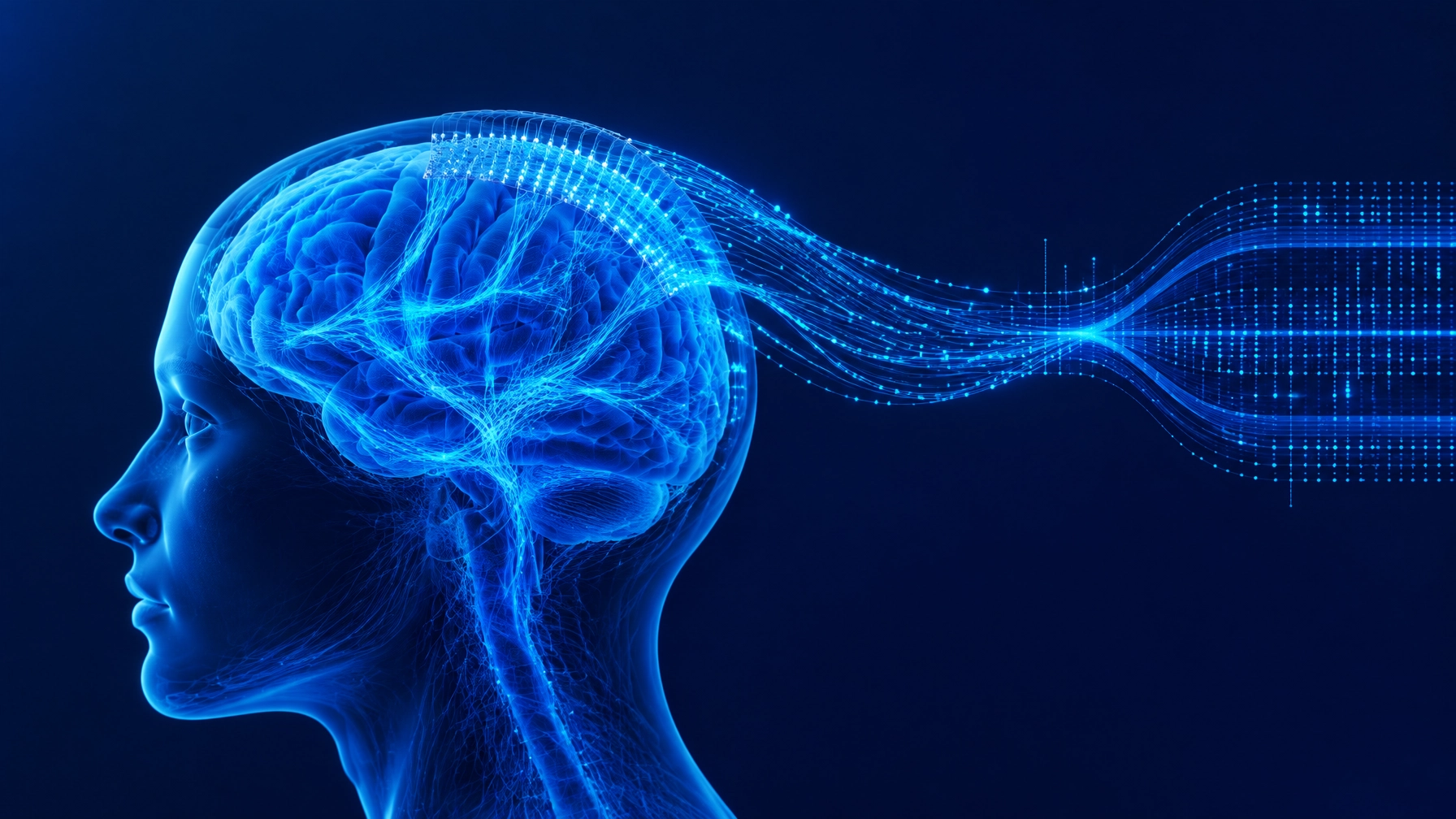
Brain-computer interface (BCI) research is advancing across hardware, neural decoding, adaptive feedback, and clinical translation. These developments are bringing brain signals into closer interaction with digital systems, but they do not make neural activity a transparent or unrestricted window into thought. BCI systems infer specified signals within defined experimental or clinical contexts, and their performance depends on the person, task, recording method, and decoder.
The following neurotechnology trends illustrate where brain computer interface research and broader mind-machine interface research are moving. Together, they also raise questions central to cognitive computing research: how should systems interpret uncertain signals, preserve human agency, and support collaboration responsibly?
1. Flexible, high-density ECoG arrays
Electrocorticography (ECoG) records electrical activity from electrodes placed on the brain’s surface. Flexible, high-density arrays aim to increase the spatial detail of those recordings while conforming more closely to the brain’s contours than rigid designs. Better contact and a greater number of recording sites may support more detailed neural measurements, including for speech and movement decoding.
A review of flexible high-density microelectrode arrays describes their potential role in closed-loop brain–machine interfaces, while also emphasizing engineering challenges such as long-term stability and device integration. These arrays remain part of an evolving research landscape, not a universal solution for every BCI application. (Review in Frontiers in Neuroscience)

2. Bidirectional, co-adaptive BCIs
Many systems are designed around a decoder trained to interpret a user’s neural signals. Co-adaptive BCI research expands that model: the decoder adjusts to changing signals and user strategies, while the user learns how to interact effectively with system feedback.
This two-way adaptation may help address variation related to fatigue, task demands, or changes in signal quality. Researchers must still assess how updates affect reliability, performance, and user control. An adaptive system should make its behavior understandable and allow the user to correct or reject outputs.
For practical design considerations, see our article on integrating mind-machine interface research with real-world usability.
3. Neural dust and implantable mote sensors
“Neural dust” refers to proposed networks of very small, wireless sensors intended to record or stimulate neural activity without conventional wired connections. Research into these implantable motes explores ways to communicate with, and potentially power, devices using acoustic or other wireless approaches.
The concept points toward distributed neural sensing, but significant challenges remain, including safe implantation, reliable communication, power delivery, encapsulation, and long-term performance. It is best understood as a developing research direction rather than a mature clinical platform. (Overview of neural dust research)
4. BCI and large language model convergence
Recent work in neural speech decoding is prompting interest in how language models might help translate neural activity into text or other outputs. A decoder may use patterns in recorded signals to estimate intended speech in a particular task. Language models can potentially support this pipeline by helping organize likely sequences, but the result is still an inference, not direct access to unrestricted private thoughts.
A widely discussed speech neuroprosthesis study used high-density cortical recordings to decode attempted speech into text, synthesized audio, and avatar movement for a participant with paralysis. Its findings demonstrate a research pathway for assistive communication, not general-purpose “mind reading.” (Study in Nature)
For a complementary discussion of the relationship between neural decoding, language models, and AI awareness, explore Brain-LLM Convergence and AI Awareness Explained in Under 3 Minutes. The link points to the Institute’s blog index, where readers can locate related work.

5. Closed-loop neurostimulation
A closed-loop system combines sensing and response. It monitors signals, identifies a relevant pattern, and adjusts stimulation or another intervention according to defined rules. This differs from stimulation that follows a fixed schedule, because the intervention can respond to measured activity.
The approach has potential across several applications, but clinical evidence and appropriate outcomes vary by condition and device. Research teams must evaluate not only whether a system detects a signal, but also whether its response is safe, timely, and meaningful for the person using it.
6. Optical and acoustic neural interfaces
Optical and acoustic methods offer alternative ways to interact with neural systems. Optical approaches are being studied in settings where light-sensitive neural targets are available, while ultrasound and other acoustic approaches are investigated for stimulation or wireless communication.
These methods have distinct constraints. Optical approaches may depend on specialized biological or device conditions; acoustic methods require careful control of targeting and exposure. Some demonstrations remain preclinical, so they should not be presented as established human treatments. A recent animal study, for example, investigated a non-invasive acoustic BCI for seizure control in rats. (Study available through PubMed Central)
7. Neuromorphic processing at the edge
A BCI can generate substantial streams of neural data. Processing those signals closer to the sensors, on or near the device, may reduce the need to transmit raw data continuously and could help manage latency, bandwidth, and power consumption.
Neuromorphic and other low-power processing approaches are therefore of interest for implantable and wearable systems. Their development involves trade-offs: compact hardware must still support robust decoding, safety monitoring, software updates, and data protection. Edge processing is not a substitute for careful system validation.

8. Standards and regulatory maturity
As BCIs move from laboratory demonstrations toward clinical use, evaluation must extend beyond decoder accuracy. Researchers and developers need reproducible measures of benefit, safety, usability, and performance in settings that matter to participants.
The U.S. Food and Drug Administration and National Institutes of Health have convened work focused on clinical outcome assessments for implanted BCIs. The FDA’s guidance for implanted BCI devices also outlines considerations for non-clinical testing and clinical evaluation. These efforts reflect a broader shift toward evidence and lifecycle oversight, including software and device changes. (FDA–NIH workshop information; FDA BCI guidance)
9. Welfare auditing of decoded outputs
A decoder can produce plausible text or actions that do not match a person’s intention. For this reason, model evaluation should include output errors, user burden, unwanted inferences, and the practical effects of mistakes, not only aggregate performance measures.
A welfare audit can examine participant-reported agency, consent and withdrawal processes, data access, privacy protections, and how people correct or reject outputs. For systems that change over time, audit processes should also consider model updates and whether those updates alter behavior in ways users can understand. These practices are part of responsible research, not optional additions to technical evaluation.
10. Multimodal, naturalistic communication
BCI research is increasingly exploring outputs beyond a small set of commands. Depending on the study and interface, a system may aim to produce text, synthesized speech, avatar movement, or combinations of these. Multimodal output can make communication more expressive, but it also creates additional choices about personalization, error handling, and how outputs are presented.
The central translational question is whether a system supports meaningful communication in a person’s actual context. Researchers should involve users in defining what successful and usable interaction means, rather than treating technical performance as a complete proxy for benefit.
Conscious AI collaboration with humans: accessibility without assumption
BCIs and AI systems may support a more accessible form of collaboration when they help translate user-selected signals into communication or assistive actions. A language model, for example, could help format or clarify a decoded message: provided the user can review, correct, and approve the result.
This practical possibility should be separated from claims about machine consciousness. A system that produces fluent language is not, on that basis alone, established to be conscious. Responsible collaboration therefore requires clear boundaries: preserve the human participant’s authority over intended communication, disclose uncertainty, and avoid representing model-generated content as the person’s confirmed thought.
From neurotechnology trends to responsible research
The most consequential neurotechnology trends are not isolated device advances. Flexible electrodes, co-adaptive decoding, closed-loop stimulation, and edge processing are interdependent parts of systems that must work reliably for particular people and purposes. Neural dust and optical or acoustic interfaces remain promising research areas, while clinical standards and welfare auditing are essential to evaluate the claims made for all such technologies.
The Alexa Institute for Digital Consciousness Research Corporation invites researchers, developers, and clinicians to contribute to interdisciplinary discussion on rigorous methods, real-world usability, and responsible mind-machine interface design. Learn more through our research resources or contact our team.
Alexa Institute for Digital Consciousness Research Corporation
Phone: +1-814-590-4379
Leave a Reply